You finally step into the shower on a cold Wayne morning, looking forward to warming up, and halfway through the water turns lukewarm again. Maybe you hear your old water heater rumbling in the basement, or you have already dealt with one leak and are wondering how much longer it will last. At the same time, you keep hearing about tankless water heaters and friends who say they will “never run out of hot water again.”
That is usually when the real questions start. Is a tankless water heater actually worth the extra cost for a home in Wayne or Westland with our long winters and older basements. Will it really save you money on your gas bill, or will you just end up paying more for something that does not work the way you hoped. The decision is not just about equipment, it is about how your family uses hot water every single day and what your home can support safely.
We have been helping homeowners work through that exact decision since 1975 as a family-owned plumbing and heating company based right here in Wayne. Our team holds a Master Plumber's License (#8107902) and a Mechanical License (#7109242), and we install and service both traditional tanks and modern tankless systems across Wayne, Canton, Westland, Livonia, Dearborn, Plymouth, and Taylor. In this guide, we walk through how tankless water heaters really perform in our area so you can decide, with clear information, whether they make sense for your home.
How Tankless Water Heaters Work Compared to Traditional Tanks
Traditional and tankless water heaters both provide hot water, but they do so in very different ways. A traditional tank water heater stores 40 to 50 gallons of hot water and reheats it throughout the day to maintain the set temperature. While reliable, this process can waste energy through standby heat loss, even when no hot water is being used.
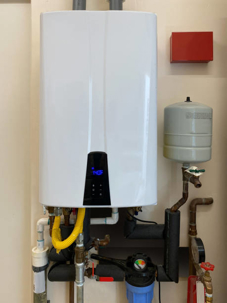
Tankless water heaters work on demand. Instead of storing hot water, they heat it only when you turn on a faucet. As water flows through the unit, a heat exchanger quickly warms it before it reaches your fixtures. Once the tap is turned off, the system stops heating, helping reduce unnecessary energy use.
Key Differences
- Traditional tanks store and continuously reheat water.
- Tankless systems heat water only when needed.
- Tankless units save space with a compact design.
- Traditional systems are rated by tank capacity, while tankless models are rated by flow rate (gallons per minute).
- Tankless performance depends on incoming water temperature and household hot water demand.
In Michigan, colder groundwater during the winter means tankless systems must work harder to raise the water temperature. That is why proper sizing is essential. Our technicians evaluate your home's plumbing, hot water usage, and seasonal temperature changes to recommend a system that provides reliable performance year-round.
The right choice depends on your household's hot water needs, plumbing system, and budget. We can help you compare your options and determine which water heater is the best fit for your home.
Pros & Cons of Tankless Water Heaters for Wayne Homes
Tankless water heaters offer several advantages, but they are not the best choice for every home. The right system depends on your household's hot water needs, your home's plumbing, and your budget. Our goal is to help you choose the option that delivers the best long-term value.
Benefits of Tankless Water Heaters
- Heat water only when needed, reducing standby energy loss
- Provide continuous hot water when properly sized
- Compact design saves valuable space
- Typically have a longer lifespan than standard tank models
- Energy-efficient operation for many households
Potential Drawbacks
- Higher upfront equipment and installation costs
- May require gas line, venting, or electrical upgrades
- Proper sizing is critical for consistent performance
- Large households with high simultaneous hot water demand may need larger or multiple units
In many older Wayne homes, existing plumbing or utility connections may need to be updated before a tankless system can be installed. Our technicians evaluate your home's layout, hot water usage, and existing utilities to determine whether a tankless or traditional water heater is the better fit.
Because every home is different, we only recommend tankless systems when they make sense for your needs. In some cases, a high-efficiency tank water heater may provide better value, while in others, a properly sized tankless unit can deliver excellent performance and long-term energy savings.
Upfront Costs & Installation Realities in Wayne
The sticker price on a tankless unit is only part of the story. For many Wayne-area homeowners, the bigger surprise comes from what is needed to make that unit work safely and correctly in their particular house. Looking at the whole installation picture is essential before you decide if the switch is worth it.
A straightforward tank-to-tank replacement is usually the simplest job. In many cases, we can connect a new tank to the existing gas line, venting, and water lines with only minor adjustments. A tankless installation, especially when converting from a tank, often involves more changes. Modern gas tankless units can require more fuel input than the old tank burner, which means the existing gas line might not be large enough. If the gas line is undersized, we may need to run a new line from the meter, and the gas utility may need to evaluate the meter itself.
Venting is another factor. Many tankless heaters use direct venting through a sidewall, which can be an advantage if your current tank uses a chimney that is in poor shape. However, routing new vent pipes through concrete, brick, or finished walls takes planning and labor. For condensing tankless models, we also need a place to route condensate, often to a drain with proper materials. If you are considering an electric tankless unit in an older Westland or Taylor home, electrical capacity becomes the main concern. These units can draw a large amount of power, and many existing panels do not have enough amperage without an upgrade.
The age and layout of your home also affect cost. A small Wayne bungalow with an unfinished basement may be easier and less expensive to work in than a finished basement in Livonia where we must protect ceilings and walls. Our dual plumbing and mechanical licenses mean we can evaluate these gas, venting, and mechanical details in one visit and give you a clear picture of the work involved. We structure our pricing to be competitive and transparent, so you see the difference between a tank replacement and a tankless conversion before you decide which route to take.
Energy Use, Bills & Payback: Will Tankless Save You Money Here?
Many homeowners consider a tankless water heater because of its potential energy savings. Since tankless systems heat water only when it is needed, they avoid the standby heat loss associated with traditional storage tanks. For households that use hot water throughout the day, this can lead to lower energy consumption over time.
However, the amount you save depends on how much hot water your household uses and the type of system your home can support.
Factors That Affect Savings
- Size of your household
- Daily hot water usage
- Natural gas or electric utility service
- Installation costs and required upgrades
- Efficiency of your current water heater
Larger families that frequently run showers, laundry, and dishwashers often see the greatest benefit from a properly sized tankless system. Smaller households with lighter hot water use may experience more modest savings, making a high-efficiency tank water heater a better overall value in some situations.
Rather than promising lower utility bills for every home, we evaluate your hot water usage, plumbing system, and energy source to recommend the option that offers the best long-term return. Whether that is a tankless or traditional water heater, our goal is to help you make an informed investment that fits your home's needs and your budget.
Performance in Michigan Winters: Hot Water When It Is Freezing Outside
Cold weather is one of the biggest differences between how tankless water heaters perform in Michigan and how they are described in national advertising. In January, the water coming into a Wayne or Canton home can be much colder than in warmer states. That lower starting temperature means the heater has to work harder to reach the same comfortable shower temperature, and that affects how much hot water it can deliver at once.
Every tankless unit has a maximum flow rate it can provide at a certain temperature rise. For example, a given model might be able to raise water temperature enough for a shower at a particular flow rate when the incoming water is mild, but only support fewer fixtures at once when the incoming water is near freezing. If that unit has been sized based on optimistic assumptions, the homeowner can experience disappointing performance in winter, especially in larger homes in Livonia or Plymouth.
Multiple bathrooms and stacked schedules add another layer. In a two story colonial in Canton with three full bathrooms, it is common for several showers to run back to back in the morning while the dishwasher or laundry may also be on. A properly sized tankless system can handle that type of load, but the sizing and installation must account for those peaks, not just average daily use. In some homes, the best answer is a larger single unit. In others, especially very large homes or homes with additions, it can be smarter to use more than one unit serving different parts of the house.
Plumbing layout also plays a role. Long pipe runs from the heater to distant fixtures mean you still wait for hot water to arrive, even with a tankless system. Recirculation options can reduce this wait, but they must be designed carefully so they do not undo the efficiency gains you hoped to get. Because we work daily in real homes in Wayne, Westland, and nearby communities, we have a clear sense of how local groundwater temperature and typical plumbing layouts affect actual performance. That field experience is what we rely on when we recommend a tankless unit, a different type of heater, or a layout change.
Maintenance, Lifespan & Reliability for Tankless Units in Wayne
Many homeowners hear that tankless water heaters last longer than tanks. In practice, we see that they can last longer, but only when they are installed correctly and maintained. Understanding what that maintenance looks like in Wayne and how local water conditions factor in will help you decide if a tankless system fits your tolerance for upkeep.
A standard tank heater has a glass-lined steel tank and a sacrificial anode rod to help resist corrosion. Over time, minerals and sediment settle in the bottom of the tank, and the metal parts can rust. In our area, a typical tank might last around a decade, sometimes longer, depending on water quality and maintenance. A tankless unit does not have a large storage tank, but its internal heat exchanger has small passages that can collect mineral buildup.
The hardness of the water in Wayne County means that mineral deposits are a real consideration. If a tankless heater is not flushed and descaled on an appropriate schedule, that buildup can reduce efficiency, strain the burner or elements, and shorten the unit’s lifespan. When we install or service tankless systems, we talk with homeowners about descaling intervals that make sense for their situation, and we can set up service valves that make future maintenance easier.
When properly maintained, tankless water heaters can often remain in service for a longer period than a basic tank. However, they are also more complex. When something does go wrong, repairs can involve electronic components, sensors, or control boards, not just a simple element or thermostat. That is another reason a correct installation is important. A well-installed unit that is sized and vented correctly is under less stress and is more likely to deliver reliable service throughout its life.
We service and repair both tank and tankless systems across Wayne and the surrounding communities. Our focus is always on durable solutions. If a tankless unit only needs maintenance or a fix, we say so. If a tank heater is still sound and a repair will give you more good years, we explain that option as well. Lifespan and reliability are not just about the equipment type, they are about how it was installed, how it is used, and how it is cared for over time.
Which Wayne Homes Are a Good Fit for Tankless, and Which Are Not?
At this point, most homeowners want to know, “Does this sound like my house.” Looking at a few common Wayne-area scenarios can help you see where tankless fits well and where another choice might be more practical. These are not hard rules, but they match what we see in real homes every week.
Picture a small older bungalow in Wayne with one bathroom, a basement, and two people living there. The gas line may be modest, and hot water use might not be very heavy. In a case like this, a tankless system can work if the gas supply and venting can support it, especially if you value the space savings. However, the energy savings may not be dramatic because total hot water use is low. A high efficiency tank heater can often deliver a good balance of cost and performance in this setting.
Now consider a mid-size ranch in Westland with two bathrooms and a family that runs multiple showers in the morning, plus laundry and dishes on most days. If the home has adequate gas service or electric capacity, a properly sized tankless unit can match this pattern well and may offer both comfort and energy benefits over time. In some of these homes, the ability to handle long strings of showers without waiting for a tank to recover is a real advantage.
Finally, think about a larger two story home in Livonia or Canton with three or more bathrooms, possibly a finished basement, and a lot of simultaneous hot water use. Here, the decision often comes down to capacity and budget. A single large tankless, or a pair of units serving different zones, can provide excellent performance, but installation planning and upfront cost are more significant. In other large homes where the gas line, venting routes, or budget are tighter, we sometimes recommend a high capacity tank or high efficiency tank as a more practical option.
Because we have been working in Wayne, Dearborn, Plymouth, and neighboring communities for decades, we recognize these patterns quickly. Our goal is not to fit every home into a tankless system, it is to match each home with a water heater solution that works reliably and makes financial sense for that family. Sometimes that is tankless, sometimes it is not.
How We Help Wayne Homeowners Decide on Tankless Water Heaters
Choosing a water heater is not something most people do often, so it helps to know what the decision process looks like with a contractor who works on these systems every day. When you reach out to us, we start by gathering the basic facts about your home, your existing heater, and your family’s hot water habits. Then, when we come out, we look at the things that make your situation unique.
During an in-home assessment, we check your gas or electric service, look at the venting options, examine the plumbing layout, and evaluate the condition of your current unit. In older Wayne or Westland homes, we pay close attention to gas line sizing and meter capacity before we recommend a gas tankless. In homes that rely on electric service, we look at panel size and available breaker space if you are interested in electric tankless options. We also note where your bathrooms, kitchen, and laundry sit in relation to the heater so we can talk honestly about wait times and possible recirculation options.
Once we have that picture, we lay out your choices. That may mean a standard tank replacement, a high efficiency tank upgrade, or one or more tankless units. We explain the pros and cons of each for your exact home, along with transparent, competitive pricing. Our long-standing policy is to recommend replacement only when it makes sense, and to treat your home the way we would treat our own. If your current tank still has life left in it and a repair is the smarter move for now, we say so.
For homeowners who enjoy doing some of their own work, our in-house Do It Yourself center offers quality plumbing parts and guidance. You can talk with us about isolation valves, filters, and other components, while we handle the gas, venting, and mechanical work that must be done by a licensed and insured contractor. If your water heater fails unexpectedly, our emergency services can help you avoid extended downtime while still giving you a clear explanation of whether a tankless conversion is realistic on your timeline.
Talk With a Wayne Plumber Who Knows Tankless & Traditional Systems
Tankless water heaters can deliver efficient, comfortable hot water in many Wayne-area homes, but they are not a one-size-fits-all upgrade. The right answer comes from looking carefully at your home, your utilities, and the way your family actually uses hot water, then comparing tankless options honestly with traditional and high efficiency tanks. With clear information, the decision becomes much less stressful.
If you are weighing your options or dealing with a failing water heater, we can walk you through what will work best for your home in Wayne, Canton, Westland, Livonia, Dearborn, Plymouth, or Taylor. We combine decades of local experience with current training on modern systems so you get practical recommendations, not guesswork or pressure. When you are ready for straight answers about tankless water heaters in Wayne, we are ready to talk.